Organizing a poker tournament at home sounds simple enough.
Get some friends together, put a few chips on the table, shuffle the cards, and off you go.
Well, almost.
Someone needs to figure out the starting stacks. The blinds need to increase at sensible intervals. You need to decide what happens when someone gets knocked out. And ideally, the tournament should finish before everyone starts falling asleep at the table.
I've been playing poker since 2014 and organizing tournaments for almost as long, from small home games with friends to office tournaments and poker club events.
Over the years, I've learned that a little preparation makes a big difference. You don't need fancy equipment or a professional tournament director. You just need a decent plan.
Here's how I'd organize a home poker tournament, including a complete example for ten players that you can use for your next poker night.
1. Start with the basics
Before getting into chips and blind structures, there are a few things you should decide.
How many people are playing?
This determines how many tables, chairs, chips, and decks you'll need.
Up to ten players can usually fit around one proper poker table, although eight or nine is often more comfortable.
If you're hosting more than ten players, you'll probably want multiple tables and a plan for balancing them as players get eliminated.
How long should the tournament last?
There's a big difference between a quick tournament lasting a couple of hours and an entire evening of poker.
Your starting stacks and blind structure will largely determine how long the game lasts, although no structure can guarantee an exact finishing time.
What's the buy-in?
If you're playing for money, agree on the amount beforehand. Make sure everyone understands what goes into the prize pool and whether any expenses will be deducted.
You can also play purely for fun, with bragging rights or a small trophy for the winner.
Are rebuys or re-entries allowed?
Can someone join again after losing all their chips? If so, how many times, and until when?
This is something you really want to agree on before the first hand. Changing the rules halfway through tends to be surprisingly unpopular with whoever is currently winning.
How will the prizes be distributed?
Decide how many places get paid and how the prize pool will be divided.
Once everyone agrees on these basics, the rest becomes much easier.
2. A complete example for ten players
If you're organizing your first home tournament and don't want to spend hours figuring everything out, here's a setup I'd suggest starting with.
Your tournament at a glance
| Setting | Value |
|---|---|
| Poker variant | No-Limit Texas Hold'em |
| Players | 10 |
| Tables | 1 |
| Starting stack | 10,000 chips |
| Starting blinds | 50 / 100 |
| Blind levels | 15 minutes |
| Breaks | 10 minutes after levels 4 and 8 |
| Tournament format | Freezeout (no re-entries) |
| Example buy-in | €20 |
| Total prize pool | €200 |
| Paid positions | 3 |
| Estimated duration | Roughly 3–4 hours |
The duration is only an estimate. How quickly players get eliminated depends on how they play, and you may need additional blind levels.
This setup gives everyone 100 big blinds to start with, which is enough to play some actual poker before the blinds start becoming uncomfortable.
Let's go through how to set everything up.
3. Give everyone a sensible starting stack
Tournament chips don't need to represent actual money.
If everyone pays €20 to enter, that doesn't mean they should start with 20 chips.
Instead, everyone receives the same number of tournament chips, and the blinds gradually increase as the game progresses.
For our example, we'll use 10,000 chips per player.
| Chip denomination | Chips per player | Total value |
|---|---|---|
| 50 | 10 | 500 |
| 100 | 10 | 1,000 |
| 500 | 7 | 3,500 |
| 1,000 | 5 | 5,000 |
| Total | 32 chips | 10,000 |
With ten players, you'll need:
- 100 chips worth 50 each
- 100 chips worth 100 each
- 70 chips worth 500 each
- 50 chips worth 1,000 each
That's 320 physical chips, with a combined tournament value of 100,000.
The colors don't matter, as long as everyone knows which denomination each color represents.
A few practical tips
Prepare the starting stacks before your guests arrive. It's much easier than counting out 320 chips while ten people are waiting to play.
If you have extra chips, keep them aside. They can be useful later when exchanging smaller denominations for larger ones.
And make sure your chip set actually contains the denominations you need. A perfectly planned structure isn't particularly helpful if you've only got four chips worth 500.
4. Set a blind structure that doesn't ruin the evening
The blind structure is probably the most important part of planning a tournament.
If the blinds increase too quickly, everyone ends up going all-in before they've had a chance to settle in.
If they increase too slowly, you might still be playing when the birds start singing.
For casual home tournaments, I generally like levels of around 15 to 20 minutes.
Fifteen-minute levels work well when you want to keep the evening moving. Twenty-minute levels give players more time to make decisions and tend to produce a slower tournament.
Example blind structure
For our ten-player tournament, I'd use:
| Level | Small blind | Big blind | Duration |
|---|---|---|---|
| 1 | 50 | 100 | 15 min |
| 2 | 100 | 200 | 15 min |
| 3 | 150 | 300 | 15 min |
| 4 | 200 | 400 | 15 min |
| Break | 10 minutes (break after level 4) | ||
| 5 | 300 | 600 | 15 min |
| 6 | 400 | 800 | 15 min |
| 7 | 600 | 1,200 | 15 min |
| 8 | 800 | 1,600 | 15 min |
| Break | 10 minutes (break after level 8) | ||
| 9 | 1,000 | 2,000 | 15 min |
| 10 | 1,500 | 3,000 | 15 min |
| 11 | 2,000 | 4,000 | 15 min |
| 12 | 3,000 | 6,000 | 15 min |
The twelve blind levels represent three hours of play, plus two ten-minute breaks. That's three hours and twenty minutes if the tournament reaches the end of level 12.
Your tournament might finish earlier, or you might need a few more levels.
If needed, you can continue with 4,000/8,000, then 5,000/10,000, and so on.
With this structure, everyone gets a break after the first hour and another after two hours of actual play. That's usually a welcome opportunity to grab something to eat, stretch your legs, or explain why that last hand was definitely a bad beat.
What about antes?
For a first home tournament, I'd skip antes entirely.
Antes can help keep the action moving, but they're another thing to remember and collect every hand.
Once everyone is comfortable with running tournaments, you can experiment with them.
Don't forget to exchange smaller chips
As the blinds increase, the smallest chip denominations eventually become unnecessary.
For example, once the blinds have moved beyond 50-chip increments, you can exchange the 50-value chips for larger denominations.
The first scheduled break, after level 4, is a convenient time to do this.
The second break, after level 8, is another opportunity to exchange denominations you no longer need.
Make sure players receive the same total chip value after exchanging their chips. If exact exchanges aren't possible, agree on a fair chip-race procedure rather than improvising one.
And whatever structure you choose, make sure everyone can see the current blinds and how much time is left.
A tournament clock on a laptop or TV is much more convenient than having someone shout "blinds are up!" every fifteen minutes.
Especially when that someone is busy playing a hand.
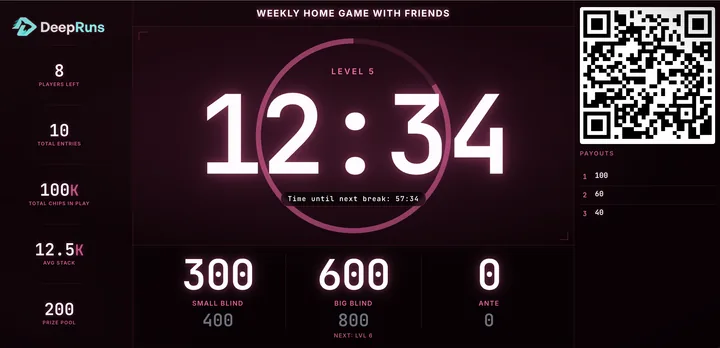
Want the timer on the TV and your players' phones? See how the DeepRuns poker tournament clock works.
5. Decide what happens when someone gets eliminated
There are several common tournament formats, and it's worth understanding the differences.
Freezeout
Once a player loses all their chips, they're out.
No second chances, no buying back in.
It's simple, straightforward, and the format I'd recommend for your first home tournament.
Re-entry
When someone gets eliminated, they can pay to enter the tournament again, usually receiving a fresh starting stack.
You can limit re-entries to a certain number or allow them until a specific blind level.
Rebuy
Depending on the tournament rules, a rebuy can allow players to purchase additional chips while they still have chips, or after dropping below a certain threshold.
The exact conditions should be agreed upon beforehand.
Add-ons
Some tournaments allow players to purchase an additional stack of chips at a specific point, often at the end of the rebuy period.
This is separate from a normal re-entry.
Which format should you choose?
For your first tournament, keep it simple and go with a freezeout.
Once you've organized a few games, you can experiment with re-entries, rebuys, and add-ons.
Just make sure everyone knows the rules before the tournament starts.
Nobody enjoys discovering that someone has bought back in for the fifth time when they thought the tournament was nearly finished.
6. Work out the prize pool and payouts
Now for the part everyone is suddenly very interested in.
Let's say you're organizing a ten-player tournament with a €20 buy-in.
That's a total prize pool of:
10 players × €20 = €200
Assuming the entire buy-in goes into the prize pool, you have €200 to distribute among the winners.
For a ten-player tournament, paying the top three places is a reasonable option.
| Position | Percentage | Prize |
|---|---|---|
| 1st | 50% | €100 |
| 2nd | 30% | €60 |
| 3rd | 20% | €40 |
| Total | 100% | €200 |
There's nothing wrong with paying only the top two positions, or even having a winner-takes-all tournament if everyone agrees.
Personally, I prefer paying a few positions. It gives players something to aim for even when winning the tournament is starting to look unlikely.
What if you allow re-entries?
Let's say three additional entries are made, each costing €20.
Your prize pool becomes:
13 entries × €20 = €260
With the same 50/30/20 distribution, the payouts would be:
| Position | Prize |
|---|---|
| 1st | €130 |
| 2nd | €78 |
| 3rd | €52 |
| Total | €260 |
If you're deducting expenses or a fee, calculate the prize pool after those deductions and make that clear to everyone beforehand.
Also, check the rules that apply to home poker games in your location, especially if you're collecting buy-ins or taking a fee.
The main rule is simple: decide the payouts before the game, not when the last three players start negotiating.
7. Seating and managing multiple tables
With ten players, things are pretty straightforward.
Assign everyone a seat, pick a dealer, and start playing.
I prefer randomly assigning seats at the beginning. It avoids the inevitable discussion about who always ends up sitting next to whom.
If you're organizing a tournament with more than ten players, you'll probably need multiple tables.
That's where a little extra planning comes in.
Balancing tables
As players get eliminated, you'll eventually have different numbers of players at each table.
For example, imagine you're running a tournament with 16 players across two tables.
You start with eight players at each table.
After a few eliminations, you might have:
- Table 1: 8 players
- Table 2: 5 players
That's not ideal, so you'll need to move players between tables.
There are established tournament procedures for deciding who moves and where they sit. For a casual home game, the most important thing is to agree on a fair method and apply it consistently.
Try to keep the number of players reasonably balanced so that one table isn't constantly playing short-handed while the other is full.
Moving to the final table
Eventually, you'll have few enough players remaining to bring everyone together at one table.
Decide beforehand when this happens and how the remaining seats will be assigned.
The goal is to make the transition smooth, rather than having everyone stand around while the organizer tries to remember who was sitting where.
And yes, I've been that organizer.
8. Keep track of results
If you're only running one tournament, you might be perfectly happy writing down the finishing positions on a piece of paper.
But if you organize regular poker nights, keeping proper results becomes much more interesting.
You can track:
- Finishing positions
- Number of entries and re-entries
- Total buy-ins
- Prize money won
- Tournament winners
- Results across multiple events
That information can be useful for seasonal rankings, leaderboards, or simply keeping track of who's been doing well.
I've organized enough recurring tournaments to know how annoying it can be to reconstruct results afterwards.
Especially when the final standings are scattered across a spreadsheet, a few messages, and someone's memory of what happened three weeks ago.
Keeping everything in one place makes life considerably easier.
9. A few things I've learned from organizing tournaments
Beyond chips and blind structures, there are some practical details that can make or break a poker night.
Be clear about the starting time
If you tell everyone the tournament starts at 7 PM, decide whether that means arriving at 7 or actually dealing the first hand at 7.
There's a difference.
And someone will definitely interpret it the wrong way.
Have a spare deck of cards
Cards get bent, marked, spilled on, and occasionally end up on the floor.
A spare deck costs very little and can save an annoying interruption.
Agree on the rules
What happens if someone acts out of turn? What if a card is accidentally exposed? Who makes the final decision when players disagree?
You don't need a hundred-page rulebook for a home game, but having some basic rules and a designated person to settle disputes helps.
Established tournament rules, such as those published by the Tournament Directors Association, are a useful reference for more formal situations.
Schedule actual breaks
People need to grab a drink, use the bathroom, get some fresh air, or explain in great detail how unlucky they've been.
In our example tournament, we've included two ten-minute breaks: one after level 4 and another after level 8.
That gives everyone a chance to recharge without unnecessarily slowing the evening down.
Think about players who get eliminated early
If you're hosting a tournament with friends, remember that the first person eliminated might have a few hours to kill.
Depending on your group, having a side game, something to eat, or somewhere to hang out can help.
Don't forget to enjoy yourself
This is probably my biggest piece of advice, particularly if you're also playing.
When you're the organizer, it's easy to spend the entire evening keeping track of everything instead of actually enjoying the poker.
You're announcing blind increases, recording eliminations, moving players, checking payouts, and answering questions.
And then someone reminds you it's your turn to act.
The less administration you have to do during the tournament, the better.
10. Let the software handle the boring stuff
After years of organizing tournaments, I got tired of juggling separate clocks, player lists, spreadsheets, and tournament results.
So, being a software developer, I did the completely reasonable thing and spent my spare time building my own tournament manager.
That's how DeepRuns started.
It's a free poker tournament manager designed to make organizing poker nights easier.
With DeepRuns, you can:
- Create tournaments with custom blind structures and breaks.
- Manage players, re-entries, and add-ons.
- Assign seats and manage tables.
- Keep track of eliminations and finishing positions.
- Calculate payouts.
- Show a live tournament clock on a TV.
- Let players follow the tournament on their phones using a QR code.
- Control the tournament from your laptop or phone.
That last part is especially useful when you're organizing the game and playing in it yourself.
The first version is completely free and supports tournaments with up to 20 players across two tables.
You don't need DeepRuns to organize a good poker night. But if you'd rather spend less time managing everything and more time actually playing poker, that's exactly what I built it for.
Final thoughts
A good home poker tournament doesn't need to be complicated.
Start with a sensible blind structure, prepare the chips, agree on the rules and payouts, and make sure everyone knows what to expect.
The first time you organize a tournament, you'll probably discover a few things you want to change next time.
That's normal.
I've been organizing poker tournaments for years, and there's always something that could be done a little better.
Just remember that the point is to have a good evening with friends.
And preferably not spend half of it arguing about the blinds.